


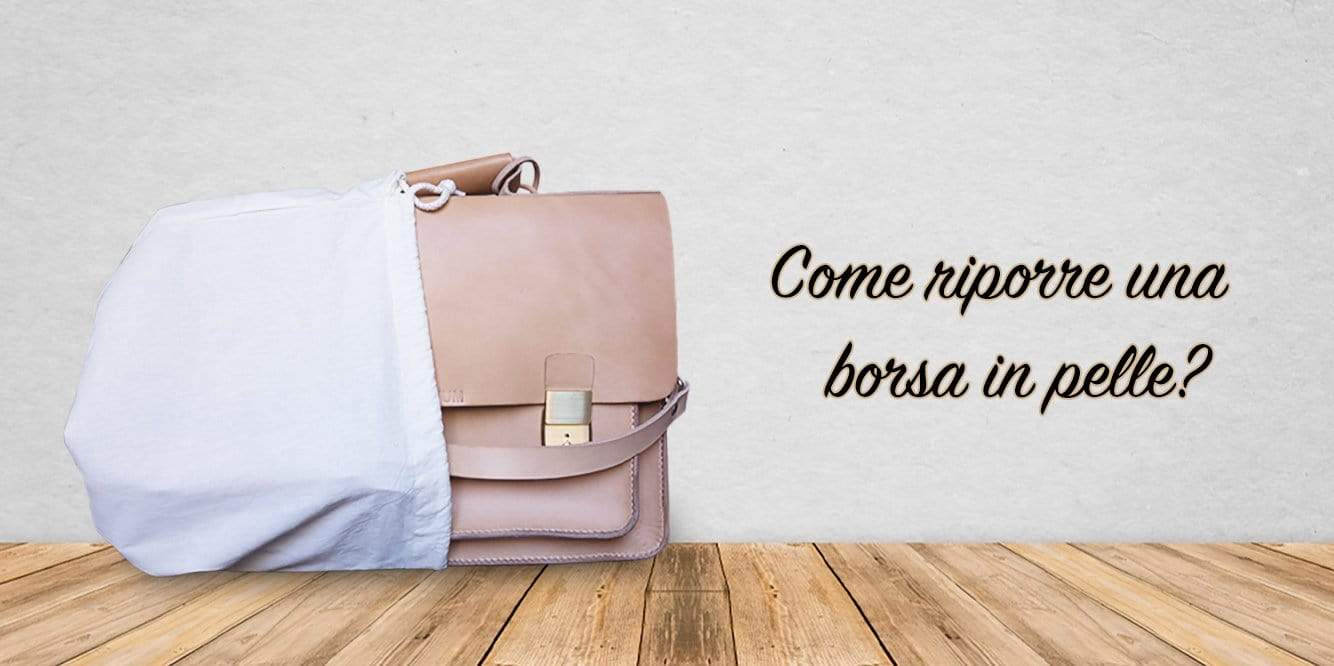
How do you store a leather bag?
This is a question my customers often ask me during the change of season.
Many of them have come to the workshop because they found their bag stained or with mold on the leather.
A few careless mistakes can ruin a handmade leather bag for good!
In this short article I have written 5 tips to avoid damaging your bags.
Want to know what they are? Let us start right away!
1. Cleaning first of all
If you need to store a handmade leather bag, the first thing to do is clean it.
Empty it completely and clear the pockets of any accumulated dirt.
Once it is clean inside, gently wipe the bag with a lightly dampened cotton cloth to remove dust.
The last step I recommend is applying a cream chosen according to the type of leather.
For handmade bags in vegetable-tanned leather, you will find on my site a nourishing wax that protects bags, belts and other leather accessories from aging.
Be careful! For a suede bag, do not apply any wax or cream! Simply clean it with a suitable suede brush.
2. Pad it!
Removing a crease from a bag that has sat still for a long time is very difficult, if not impossible!
When a bag is stored without padding, it takes on an unnatural position that forms unsightly creases.
For this reason, pad the bag using paper, preferably ink-free, such as tissue paper or kraft paper.
Can I use newspaper?
No! The risk is that the paper releases ink and stains the bag.
3. Try to avoid damp areas
Avoid storing a handmade leather bag in a damp place.
The risk, after a few months, is finding it with mold on the surface.
The ideal is to store the bag in a dry place, away from direct sunlight.
4. Keep it in a suitable dust bag
Want to store a leather bag safely?
I advise against doing it without a proper dust bag!
That could damage the product in two ways... listen carefully!
The first is the formation of mold.
The second is that if you put the bag near a colored garment, the color could bleed and stain the bag!
Want to know how to avoid this damage?
Use a cotton or flannel dust bag in a neutral color, which allows good breathability.
Some people also suggest using plastic covers.
Definitely not!
Plastic does not let the leather breathe and encourages annoying mold.
If you really must use them, do so for very short periods, making sure there is at least a minimum of air flow.
5. Silica gel sachets. Do they really work?
Many sites point to silica sachets as the solution for moisture.
Let me tell you something...
These sachets certainly have the ability to absorb moisture, but how much?
On the site of a silica sachet maker, you read that in ideal conditions they can absorb water up to 40% of their own weight.1
Generally, a sachet weighs 10 grams at most. So it can absorb 4 grams of water at most.
Want to know how much that is?
A little less than a teaspoon.
And the most common sachets are the 5-gram ones!
So can we consider the silica gel sachet a way to stop mold from attacking our handmade leather bag?
It depends.
If the wardrobe where you store the leather bag is very damp, the advice is to avoid spending money on these sachets, because they will soak up water quickly and their effect will be short-lived. What you can do instead is take the bag out once or twice a month to let it air, avoiding mold.
If there is little humidity, on the other hand, you can choose these sachets as a preventive measure.
To sum up...
A handmade leather bag needs attention and care, especially when we store it in the wardrobe.
Following the tips I have just explained will help you avoid a lot of problems!
If the article I wrote for you was useful, I just ask you to share it!
Questions or clarifications? You can leave a comment below and I will reply as soon as possible!
Thank you for reading all the way to the end of this article!
Massimiliano, artisan at Pelletteria Coryum.
1. Source: https://www.absortechaustralia.com/silica-gel-desiccants/
You can read more about silica gel sachets at: https://www.butac.it/le-bustine-di-silice/